
Yellow Vests of Paris in Iran
Street Violence, Historical Memory, and the Doctrine of Repression

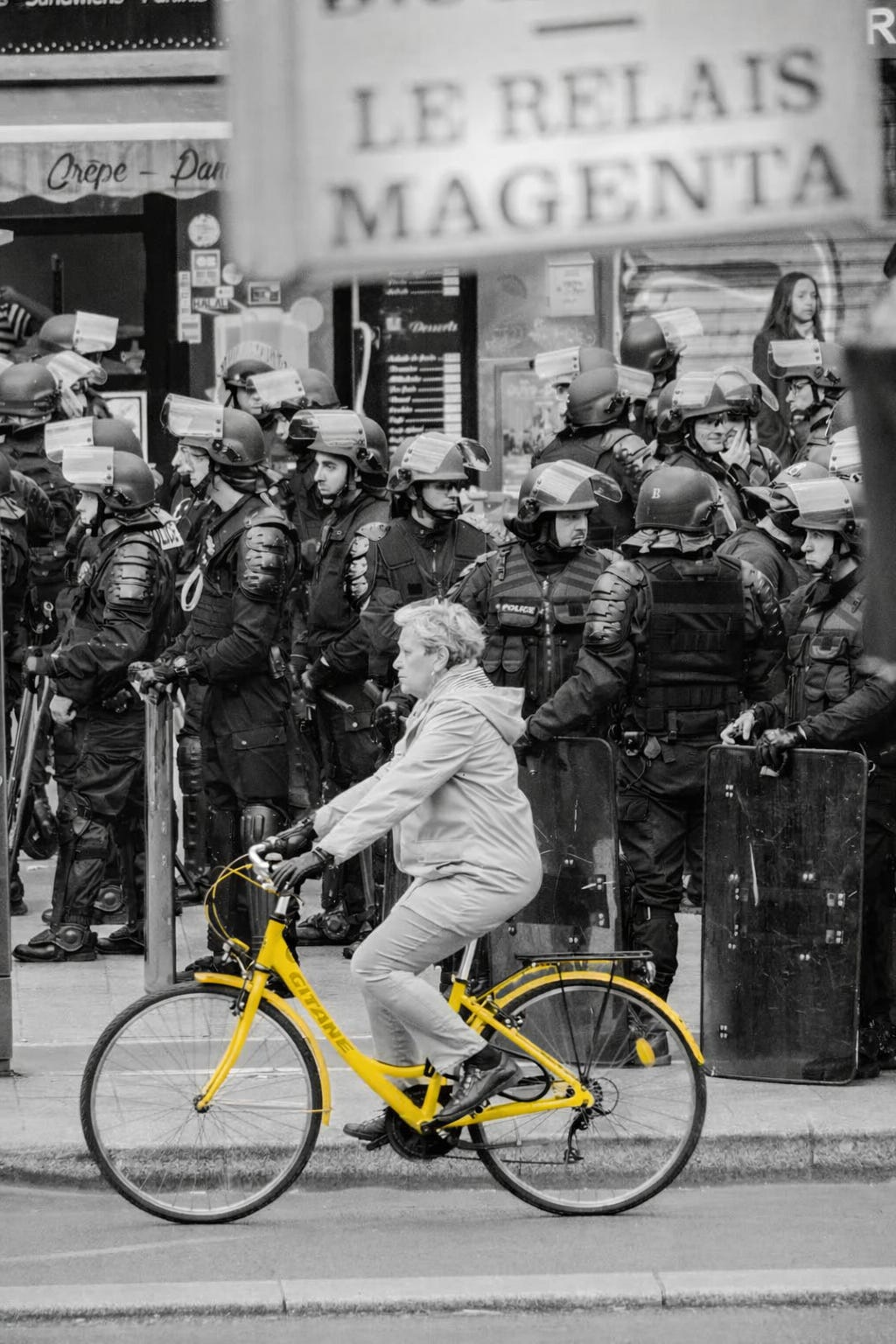
In 2018, I traveled to Paris. I found a hotel near the Champs-Élysées at an unbelievable price. I quickly read all the reviews and realized I was dealing with a reputable hotel with thousands of positive ratings. Without hesitation, I booked it and set off.
When I arrived in Paris, the metro passed my station and stopped at the next one. I changed lines, and from the other direction the same thing happened again. I assumed the station was temporarily closed. I left the metro and decided to walk to the hotel. The route was about forty minutes, and I have always loved walking through the narrow streets of Paris.
After a while, I noticed an unusual concentration of security forces and riot police. Their number was so large that I was certain something serious was underway. I approached an officer who seemed to be in command and asked whether he spoke English. He explained that a Yellow Vests gathering had turned violent and the area had been sealed off.
I showed him my hotel reservation and said I needed to reach my hotel. He smiled and said he did not recommend going and suggested I book another hotel. With a mix of stubbornness and curiosity, I replied, “I’ve paid for the hotel and they haven’t said anything. I’m going.” He said any consequences would be my responsibility and opened the way.
The further I went, the harsher the scenes became. Trash bins were burning. The sound of explosions grew louder. The smell of tear gas and smoke filled the air. Shop windows were being smashed. Cars were set on fire. People showed no restraint.
What surprised me, however, was the behavior of the police. The police were present and had control of the area, but they had not entered a logic of physical elimination. There was no widespread gunfire. There was no direct shooting at people. There was force, gas, batons, but there was a red line they did not cross.
The next day, the city looked like a ruin. Destroyed shops, shattered windows, and burn marks were visible everywhere. Yet this urban violence, despite its intensity and scale, had not turned into a mass killing. According to official statistics published in France, over the entire period of the Yellow Vests protests across the country, about eleven people lost their lives, and the number of injured — including protesters and police — was reported to be around two to three thousand. These figures were the result of months of continuous protests and dozens of waves of urban clashes.
This experience is not merely a personal observation, but an example of an institutional pattern in urban crisis management. In many European policing systems, crowd control is an independent specialized field built on the principle of minimum violence. The basic assumption is that street crises are multi-causal phenomena: a combination of social discontent, collective emotion, organized actions, opportunistic elements, and at times external interventions. The institutional response must be designed in such a way that the field does not slip out of control, without turning human life into a tool of management.
In recent weeks, Iran has faced a crisis far more extensive. Protests took shape on a national scale. Streets were blocked. Widespread destruction occurred. Confrontations between people and security forces rapidly expanded. The field was clearly a multilayered one: part of the actors were ordinary protesters, part were cores prone to escalating violence, part were opportunistic elements, and on the other side stood various police, military, and paramilitary forces, each entering the scene with different doctrines, levels of training, and rules of engagement.
In such fields, the main issue is not merely “protest,” but the management of a hybrid space in which real grievances, external agitation, targeted destructive operations, and spontaneous collective behavior are intertwined. In this kind of crisis, the boundary between civil protest, urban riot, and destabilizing operation is rapidly erased.
Moreover, street violence in Iran cannot be understood merely as the product of the moment of crisis. As I have explained in Invisible Violence, an important part of our behavioral patterns is rooted in historical memory and cultural training — especially the memory of the 1979 Revolution and the kind of official narrative of it that has been continuously reproduced in educational and social spaces. In this framework, violence is not only a reaction to political or economic pressure, but the gradual outcome of narrative construction, institutional education, and the consolidation of mental patterns that shape society’s relationship with conflict, the street, and collective action.
In Iran, numerous reports speak of tens of thousands killed and thousands more wounded, without any precise figure, independent registration mechanism, or transparent reporting being available. This very lack of reliable data is itself a sign of institutional weakness. When mechanisms of registration, reporting, and accountability collapse, the crisis moves from the security level to the level of an institutional crisis.
The central question of this discussion is not who initiated the violence. In every major crisis, there are multiple initiators. My main question is whether such a complex field could have been managed without leading to the mass killing of citizens.
In all political crises, external interventions play a role. Intelligence operations, psychological warfare, organized agitation, and destabilization projects are part of contemporary politics. But even in the presence of such factors, the decision about the level of violence is an institutional decision. This decision is made not at the level of the officer or soldier, but at the level of doctrine and institutional design.
Nevertheless, there is a fundamental difference between Paris and Tehran that cannot be ignored. In Paris, the main issue of the protests was an economic and social dispute — a demand for policy reform within the existing political order. Even in the most intense moments, the issue was not regime change or the collapse of the political system.
In Iran, the crisis was multi-dimensional from the outset. Economic, social, identity-based, and political demands gradually intertwined and led to a discourse that directly raised the issue of transition and change in the structure of power. In such a situation, the perceived level of threat to the political structure is far higher, and this structurally lowers the threshold for coercive intervention.
This difference in the nature of the demand directly affects the logic of crisis management. A protest for economic policy reform, even if it turns violent, is usually treated as a manageable crisis within the order. But a protest with the horizon of political change or transition is quickly understood as an existential threat to the structure, and the logic of response shifts from “crisis control” to “defense of survival.”
The decisive question arises precisely at this point: at what time, and at what stage, was this demand for transition neither seen, nor heard, nor institutionally represented, and therefore forced to overflow in a violent form. Violence here is not merely the product of collective emotion, but a sign of the long-term blockage of nonviolent paths to change — what I call “dignified revolt.”
From this perspective, the difference between Paris and Tehran is not only a difference in policing doctrine, but a difference in the structure’s relationship with the possibility of change. In Paris, even a violent crisis unfolds within an order in which the very possibility of internal reform is institutionally recognized. In Iran, the crisis took shape in a context where gradual paths of reform and transition had been blocked for years.
In Paris, the doctrine is based on attritional containment: buying time, controlling routes, separating active cores, limiting the field, gradually exhausting the crisis, and restoring order without crossing the lethal threshold. The guiding principle is that the death of a citizen is considered a sign of failure in crisis management.
In Iran, the implemented doctrine is based on rapid and decisive deterrence. In this model, when the crisis is interpreted as an existential threat to the structure, the speed of ending the crisis is prioritized over human cost. This is not necessarily the result of an intention to kill, but the logical outcome of an institutional design in which survival gains structural precedence over the life of the citizen.
Prevention does not necessarily mean tolerance. The literature of control provides dozens of non-lethal tools to institutions. But the question is to what extent these tools are activated while the structure still considers the crisis “manageable within the order,” and from which point onward the logic of the field shifts from crisis control to the logic of defense of survival.
In Iran, the problem is not only a lack of training. The problem is the relationship between change, security, and human life in the governing intellectual system. To what extent peaceful transition is recognized as legitimate, and from which point onward every demand for change is redefined as an existential threat.
The decisive point is not what narrative is placed on the crisis. National security, public order, survival of the structure, or preservation of stability are concepts used in all political systems. The decisive point is whether the political structure is fundamentally designed to confront crises of transition without crossing the threshold of mass killing.
This discussion is not a defense of any side. Not a defense of protesters, not a defense of security forces, not a defense of the political system. This discussion concerns a deeper institutional issue: the capacity of a political structure to hear, represent, and manage demands for transition before they are forced to become violent.