
The Most Suffering Nation in the World
North Korea and Iran from the Perspective of Suffering and Life Satisfaction

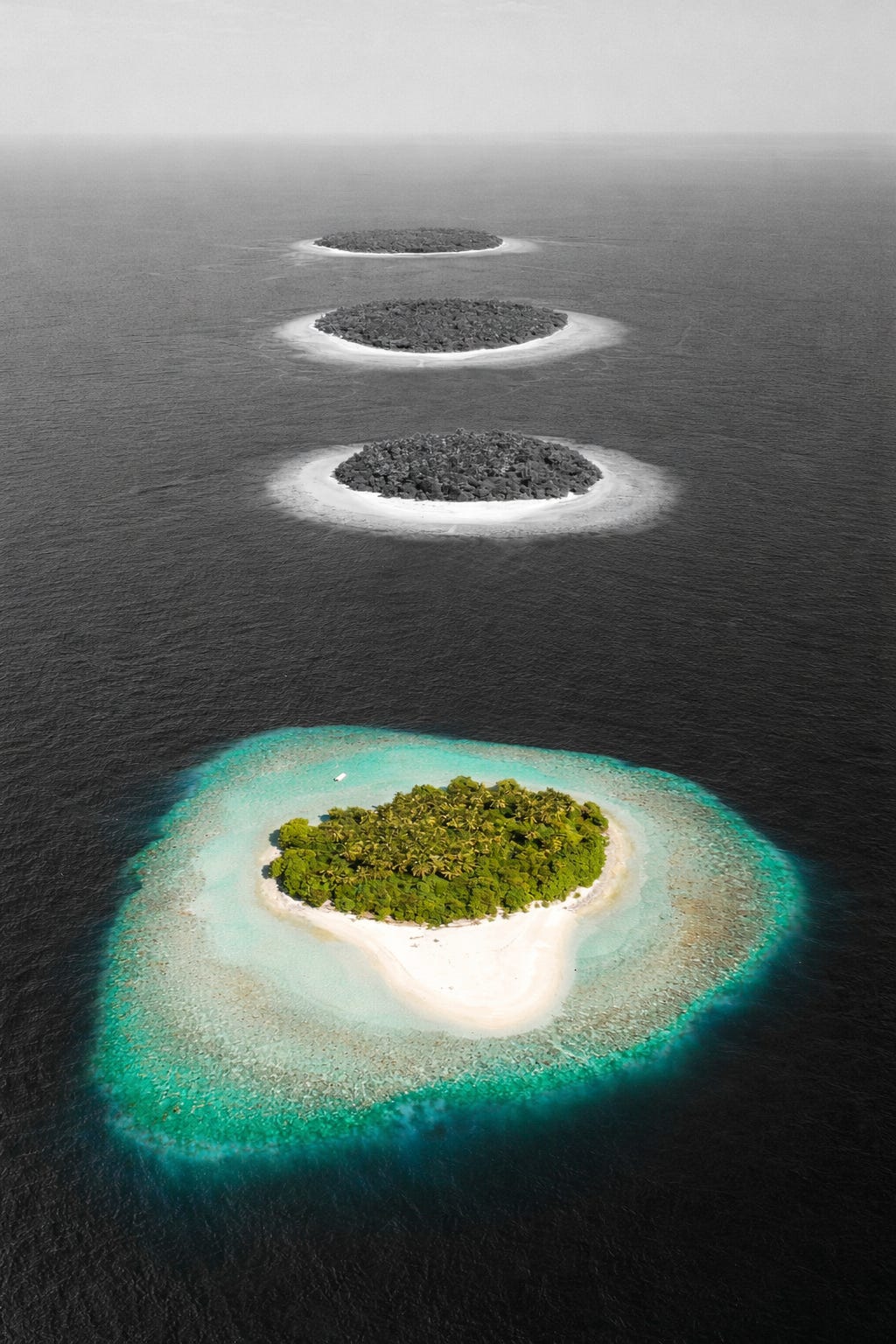
In Invisible Borders, in the section devoted to “narratives of control,” I have tried to show that freedom, suffering, and satisfaction are, before being political or legal phenomena, mental structures: products of the relation between memory, expectation, and the sense of control. What a human being experiences is not merely a reflection of external conditions, but the result of the distance that forms between what is and what the mind expects to be.
In that same place, to clarify this distinction, I used a simple allegory:
Let us imagine three human beings, all living on a remote island that is, in every respect, identical for all of them. An island with a suitable climate, sufficient food, and relative safety. The difference among these three people lies not in the environment, but in their mental pre-backgrounds.
The first person was born on this very island. He has no image of the outside world. He has never experienced any alternative possibility. For him, this island is neither a limitation nor an opportunity; it is the whole world. Concepts such as freedom, deprivation, or happiness have not yet become problematic for him, because he has nothing to compare his situation with. What exists simply appears natural.
The second person has come to this island by his own choice, for a holiday. He knows that he will return. He understands his presence on the island as the result of a personal decision. This attribution of his condition to his own choice activates a sense of control in his mind. For him, the island is not a prison, but a pleasant place, even a symbol of freedom, because he relates his presence to his own will.
The third person, however, is an exile. He has been separated from his home, his city, his relationships, and his possibilities, and sent to this island. He carries the memory of another life. He has a vivid image of freedom, choice, and a different future in his mind. Now, even if in practice he faces no concrete limitation, the island is for him not nature, but negation. Not merely the absence of a road, but the denial of the right to move. His suffering is produced not by the conditions of the island, but by the gap between what is and what should have been.
In this allegory, the external conditions are almost identical, yet the experience of suffering is entirely different. What creates this difference is not the environment, but memory, comparison, and the sense of control.
If we extend this model to human societies, the relation between North Korea and Iran becomes clearer from this perspective.
In this framework, the experience of happiness and suffering is not the direct product of external conditions, but a construct formed by the horizon of expectations, the range of comparisons, and the space of possibilities that the mind considers conceivable for itself. Human beings suffer not because of what they lack, but because of what they believe they could have had.
From this point of view, North Korea is a profoundly unjust society in which institutional discrimination, a hereditary caste-like system, and severe inequality exist. The Songbun system places citizens in fixed political classes from birth and determines their educational, occupational, and even nutritional destinies. Yet the essential difference between this society and modern capitalist societies lies not in the absence of discrimination, but in the way discrimination is perceived. Inequality in this society is not constantly made visible, displayed, and rendered comparison-provoking. The privileged class does not present itself in a public media showcase. Conspicuous consumption does not exist. There is no network for endless horizontal comparison. As a result, a large part of the chronic suffering produced by symbolic humiliation, class shame, and crises of self-worth in modern societies is not generated here in this particular form.
A society with extremely limited access to information, without the possibility of sustained comparison with the outside world, without a collective memory of a long period of prosperity, and without a stabilized image of an alternative life. In such a society there is poverty, there is repression, there is deprivation, but the narrative gap is narrower. Broad expectations do not form, or remain very weak. The concept of a “lost right” can hardly stabilize, because the mind does not possess the necessary tools to construct it. This description is neither a defense of repression nor a recommendation of a model; it is merely the description of a cognitive mechanism.
By contrast, the situation of Iran can be seen as a classic example of a society in which all the components of producing narrative suffering are simultaneously active.
A society with a historical memory of past greatness, with direct experience of relative prosperity in previous generations, with constant access to images of other forms of life through media, migration, and global connections, and with abundant resources that it knows could allow a better life, but cannot. Today’s Iranian is not only deprived, but knows that he could have not been deprived. Not only constrained, but carries a clear image of possible freedom in his mind. Not only poor, but bears the memory of having once enjoyed prosperity. This is precisely the situation I described in Invisible Borders as a “persistent gap between narrative and experience”: a point at which the mind can no longer construct a credible story about its own future.
In such a condition, suffering is produced less by absolute poverty than by violated expectation. A society that believes in a different future but sees no credible path toward it becomes trapped in a form of chronic dissatisfaction that neither fades with temporary improvements nor dissolves with superficial changes.
This is how I come to see the people of Iran as the most in-suffering nation in the world.