

نویسنده: علی دلشاد تهرانی
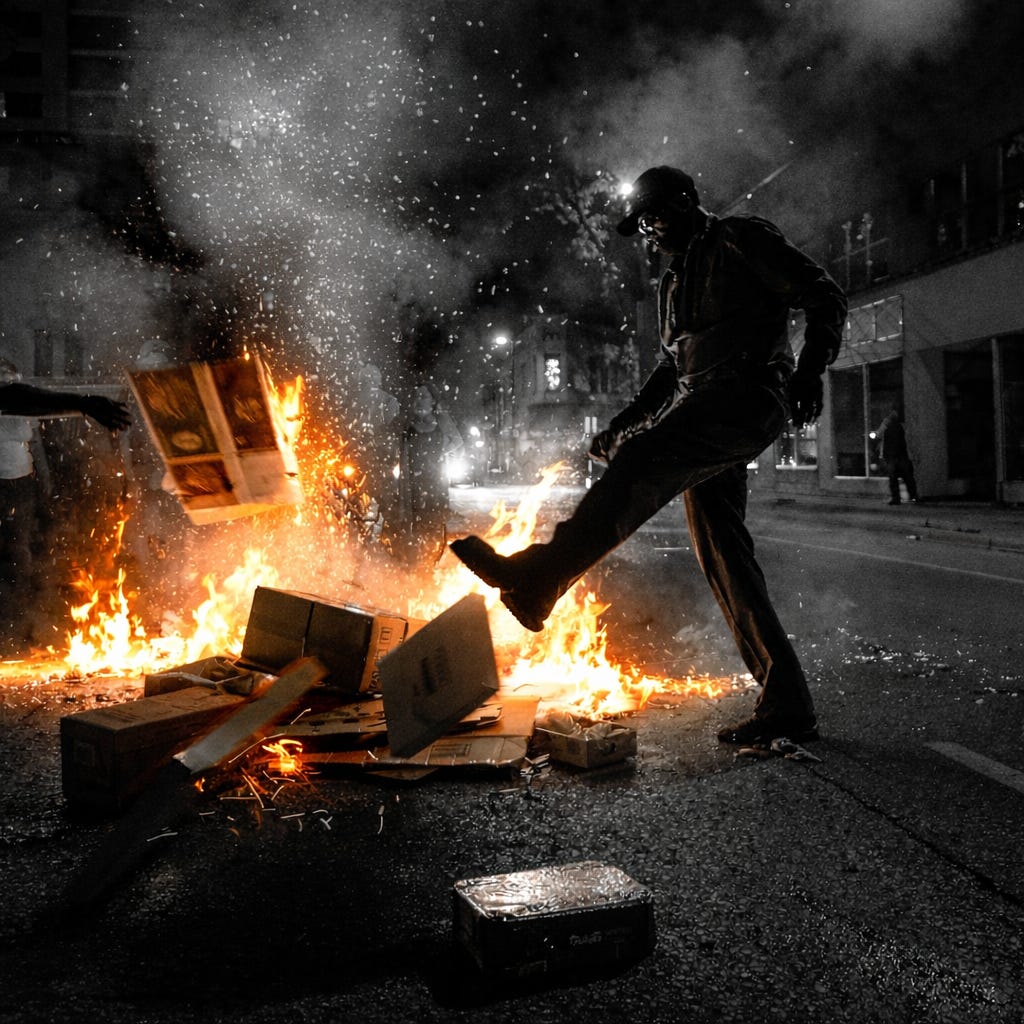
In some societies, the street turns into a field of dialogue—but a dialogue whose language is violent from the very first moment: stones, Molotov cocktails, fire, destruction, Guns and ultimately killing. This pattern is neither the result of momentary anger nor merely a reaction to political or economic pressure. What appears on the street is the direct outcome of years of education, narrative construction, and the reproduction of mental patterns.
This behavior is not abnormal. From an evolutionary perspective, humans are beings who, under threat, have learned aggressive defense and the elimination of rivals. This is examined in detail from an evolutionary–neuroscientific perspective in the section On Why We Fight in Invisible Borders.
In Iran, children are introduced to “revolution” from the earliest years of schooling—but not as a historical event with complex layers, costs, failures, and long-term consequences. Revolution is taught as an aestheticized, heroic narrative. Wallpapers, anthems, ceremonies, and romanticized commemorations all reinforce a single message: change is not possible without violence. The street is the birthplace of the hero, and violence is not an error but a sign of courage and resistance.
In such an environment, the child does not learn that conflict can take multiple paths. They learn that when you reach a dead end, you must go to the street. They learn that shouting, fire, and destruction are legitimate tools of action. Gradually, this pattern becomes fixed in the mind and, in adulthood, turns into an automatic response.
France offers a different but structurally related example. The tradition of the French Revolution, from the eighteenth century to today, has legitimized the street as a tool of political pressure. Strikes, riots, arson, and clashes with the police have become part of the historical memory and political identity of this society. The difference is that in France these behaviors are mostly reproduced within a secular and labor-oriented tradition, rather than an ideological or religious one. Still, the underlying mental model is shared: the street is where rights must be taken, not merely demanded. Here too, violence—though more limited and controlled—remains part of the language of collective action.
In Iran, this pattern is reinforced through imagery of “resistance” and simultaneously rooted in religious myths. Palestinians are often represented as symbols of victimhood for whom the only possible response is throwing stones or taking up arms. This image is usually presented without complex historical, geopolitical, or human context, and alongside it religious narratives enter the scene. The implicit message is clear: if you are oppressed, you must rise; if you lack power, violence is legitimate; and if you are killed, you will be sanctified. Within this framework, violence shifts from an emergency reaction to a moral and identity-based virtue, and the street becomes the stage for the continual reenactment of this myth.
When such patterns are planted in the mind from childhood, they no longer remain confined to religion or politics. They become a cognitive framework for understanding the world. The individual learns that rights are something to be taken, not built, and that taking them often passes through the street and confrontation.
By contrast, in many Nordic countries, education begins from a different point. Instead of practicing physical defense or forcibly taking one’s rights, children practice dialogue. In the classroom, they play different roles: complainant, accused, observer, and even the one who has made a mistake. They learn that the world cannot be seen from only one angle and that the other is not necessarily an enemy. Conflict, rather than becoming a field of elimination, becomes a field of mutual understanding.
In these countries, the issue of Palestine is usually discussed within the frameworks of human rights, international law, and the humanitarian consequences of conflict—not as a model for action. Children learn that empathy with a people’s suffering does not mean reproducing their violent behavior. Education is designed to draw a clear boundary between “understanding victimhood” and “sanctifying violence.” Students are encouraged to examine opposing narratives simultaneously, to discuss different tools of protest, and to analyze the short- and long-term consequences of violence. Within this framework, the street is not a heroic stage but one costly and limited form of collective action, not its core identity. Empathy is taught, but violence is not institutionalized as the natural path to change.
In these systems, empathy is not a slogan or merely a moral virtue; it is a skill practiced repeatedly. Children are repeatedly required to place themselves in another’s position, even when they dislike that person. Over time, these exercises shape the dominant mental mechanism—one in which the first reaction is not attack.
In our formal education, by contrast, children are often trained in only one role: the self-righteous one. They are either victims or heroes. In both cases, the other is either a devil or an obstacle. There is no room left for complexity, doubt, or shared responsibility. The result is a mind that easily constructs an us-versus-them dichotomy and sees the elimination of the other not only as permissible but as necessary.
Such an educational system produces, in the future, a society that treats the street as the natural instrument of action. Street violence in this context is not a deviation; it is the continuation of the same mechanism that was formed years earlier—quietly and persistently—in classrooms, anthems, and official narratives. The street is merely the stage on which something already built in minds finally appears.